
The genius is as rare a bird as the phoenix, an apparition not to be counted upon. —Carl Jung
Death stood by his side, while he jotted down whatever his young mind had distilled in the last few years. Black thoughts engulfed him now. His highest inspiration of working day and night, even when he was in prison, was his belief that one day he would be counted among the greats in the history of mathematics. He could now see that dream as no more than a faint shadow. Perhaps, a voice shouted in his mind, I’m not going to matter. But he was not one of those warriors who put their arms down in front of despair. He was writing to his friend; he wanted to know the opinion of Gauss, that prince of mathematicians, if his work was of any importance; and he knew he would not be able to ask it himself. ‘Ask Jacobi or Gauss to give their opinion, not as to the truth, but as to the importance of the theorems.’ This twenty year old would be in a duel the next day.
Genius has a certain lure of death. And this obsession with the destroyer of worlds was present in Évariste Galois all along. ‘I will die in a duel,’ he once predicted. His father, Nicholas-Gabriel Galois, a headmaster, had committed suicide in 1829, and this genius would be spared the pain of perhaps another rejection from the mathematics community when on May 30, 1832 he would be shot in the abdomen.
His first fatal love started as an accident. He was a brilliant student of ancient languages, until one day when he sat in an algebra class. The spirits of destiny and ambition now completely possessed him. He devoured Legendre’s Geometry as quickly as one reads a crime novel, and immersed himself in studying the mathematical papers of the masters. Perhaps he had come across that famous quote of Niels Henrik Abel: ‘It appears to me that if one wants to make progress, one should study the masters and not the pupils.’ Any sort of ambition arouses envy in others, and ambition added to genius makes insigificant minds secretly despise the gifted, and thereore they spring forth into action to destroy it. Galois quickly made enemies, and his revolutionary attitude helped him make more.
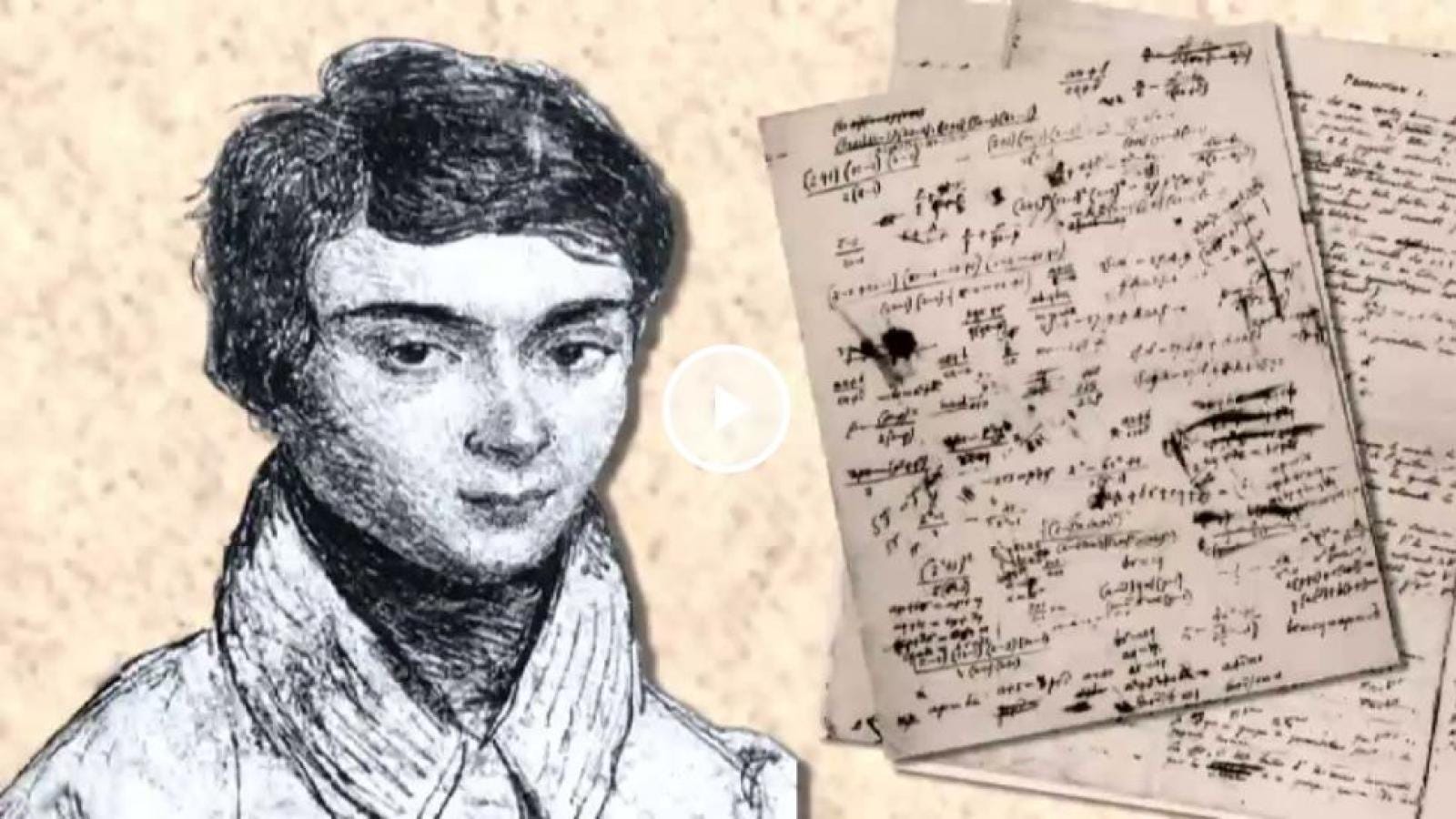
The more he became engrossed in mathematics, the more he was attracted by politics. And we can see these political activities as a release of repeated frustrations. A young genius when oppressed by his own mind wants to bury himself in anything except his calling—he wants to run away, but this is not possible.
Galois was to prove himself to be as fervent a revolutionary. In May 1831 he was arrested for plotting to kill the king. During the trial, when the prosecutor asked if he really did want to murder the king, our honest, brave, idealist genius answered, ‘Yes, if he betrays.’ The jury was moved by our young genius’ courage, and acquitted him.
But our young friend again found himself in trouble a few months later. This time he had to spend eight long months in prison. The time would have been longer had not a cholera epidemic broke out in March, 1832, and he had to be transferred to a hospital. Here he met his second fatal love–Stéphanie Dumotel.
Our young friend fought the duel for his young love on May 29, 1832. And the next day, after instructing his brother not to cry for him, he took his last breath.
‘I need all my courage to die at twenty, brother.’

 The Heavenly Cap